




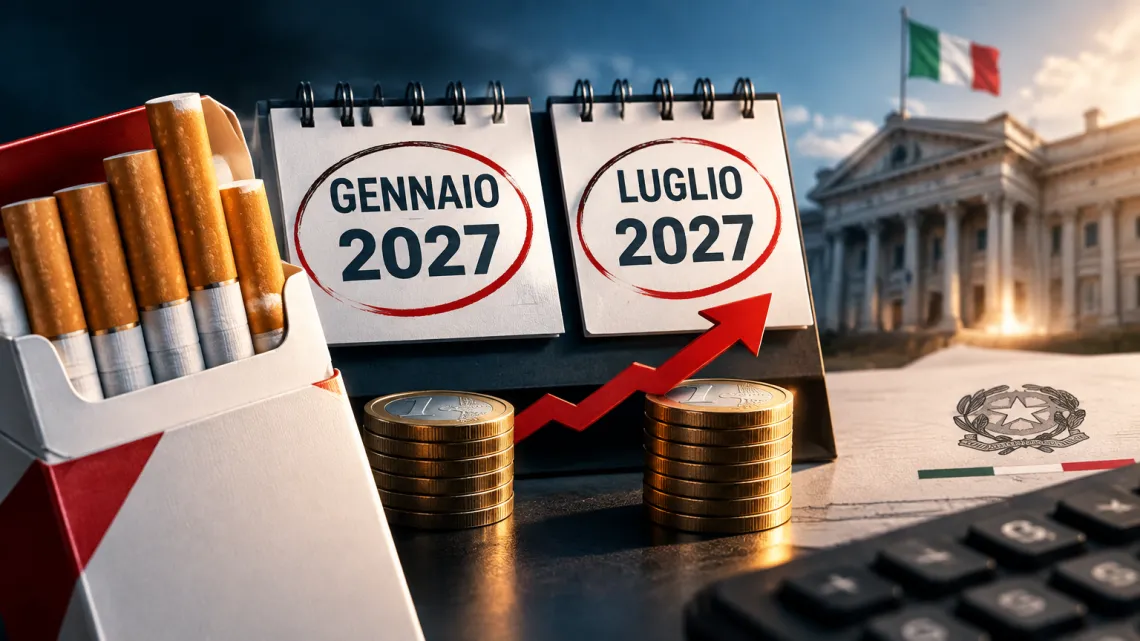
The Italian government will implement two tax increases on cigarettes in 2027 after moving forward a fiscal adjustment originally scheduled for 2028. Approved by the Council of Ministers as part of the national budget, this accelerated calendar introduces tax revisions in both January and July, directly targeting state revenue collection across a single calendar year.
According to reports from national news agency ANSA and tax advisory service Fisco e Tasse, the July adjustment is a central funding mechanism for the broader budget law. While the legislative framework establishes the tax calendar, official retail prices for individual brands will only take shape following parliamentary debate and the formal updating of tariff lists.
The Updated Fiscal Calendar for Tobacco Taxes
The decision to modify the tax calendar builds on the multi-year framework established in the 2026 budget law, which outlined tobacco tax trajectories through 2028. Under parliamentary documentation, the fixed specific excise duty was previously set at €32.00 per 1,000 cigarettes for 2026, rising to €35.50 in 2027 and €38.50 in 2028.
The revised measure compresses this schedule. Under the new draft, the specific excise duty will rise to €35.50 per 1,000 units on January 1, 2027, followed by a second increase to €38.50 per 1,000 units on July 1, 2027—six months earlier than originally planned.
| Time Period | Specific Fixed Duty (per 1,000 units) | Fixed Duty Per Pack (20 units) | Proportional Rate (Ad Valorem) |
|---|---|---|---|
| 2026 Baseline | €32.00 | €0.64 | 49.23% |
| January 1, 2027 | €35.50 | €0.71 | 48.50% |
| July 1, 2027 (Accelerated) | €38.50 | €0.77 | 48.00% |
Examining the specific duty alone illustrates the mechanics of the change. A rate of €35.50 per 1,000 units translates to €0.71 per 20-cigarette pack. When the rate climbs to €38.50 in July, that specific component reaches €0.77 per pack, representing a direct six-cent increase on that single tax layer.
How Retail Cigarette Prices Are Calculated
A change in excise duty does not immediately yield an identical price jump at the cash register. Under Italian tax regulations, the final shelf price of a cigarette pack consists of multiple independent components:
- The Manufacturer and Supplier Quota: Industrial production and distribution costs.
- Tobacconist Profit Margin (Aggio): The statutory retail commission allocated to licensed vendors.
- Value Added Tax (VAT): Standard consumption tax applied to the overall sum.
- Excise Tax: Divided into a specific fixed amount per unit and a proportional (ad valorem) percentage tied to the retail selling price.
The Ministry of Economy and Finance data highlights that while the fixed specific rate rises, the proportional rate drops incrementally—from 49.23% in 2026 to 48.50% in 2027, and down to 48.00% under the final bracket. Because the final price combines both fixed and percentage-based taxes, market analysts caution against simply adding tax adjustments together to predict final retail costs.
Initial market estimates suggested average price adjustments of roughly 25 cents per pack in 2027 and 40 cents in 2028. Merging these estimates into an assumed flat increase of 65 cents per pack in 2027 is inaccurate. Manufacturers frequently absorb portion adjustments or modify wholesale prices across different product tiers to retain market share, meaning each brand will see distinct price revisions.
Consumer Impact and State Revenue Projections
Bringing the tax increase forward by six months directly changes consumer outlays and treasury receipts. For a daily smoker purchasing one pack per day, an average price increase of 10 cents per pack amounts to an extra €36.50 across a full year. If that same 10-cent increase applies solely to the second half of the year, between July 1 and December 31, the additional cost is €18.40 across 184 days.
From the perspective of public finances, advancing the implementation date from 2028 to mid-2027 brings expected tax receipts into the 2027 budget window. The government relies on this shifted timing to fund planned spending initiatives, although official technical reports have not yet published the precise revenue yield attributed exclusively to the six-month acceleration.
Rules for Other Tobacco and Nicotine Categories
The announced double adjustment applies strictly to traditional combustible cigarettes. Italian tax law treats other nicotine categories under distinct regulatory and fiscal frameworks. These separate categories include:
- Cigars and cigarillos
- Fine-cut rolling tobacco (trinciato)
- Heated tobacco products (HTPs)
- E-cigarette inhalation liquids (with and without nicotine)
Parliamentary evaluations analyze each product category separately. Retailers and consumers cannot assume that the accelerated July timeline will automatically apply to heated tobacco sticks or vape liquids without explicit legislative text targeting those codes.
The measure now moves to the Italian Parliament for review, amendments, and final ratification. Once approved, the Customs and Monopolies Agency (ADM) will publish the binding retail price lists that define the true cost of each cigarette brand at tobacco counters nationwide.

Vape Industry Content Creator | Product Reviewer | Harm Reduction Advocate
Daniel Brooks is a vape industry content creator with a strong focus on product reviews, device performance, and consumer education. With extensive hands-on experience using disposable vapes, pod systems, and e-liquids, Daniel provides practical, unbiased insights for adult consumers.